In today's ecommerce landscape, dominated by constantly rising Customer Acquisition Costs (CAC) and a looming cookieless future pushing towards greater reliance on first-party data, the ability to maximize Customer Lifetime Value (CLTV) is no longer an option, but a strategic necessity. Many ecommerce businesses focus almost exclusively on acquiring new customers, neglecting the hidden profit potential in the post-purchase phase. This short-sightedness leads to an unsustainable cycle of marketing spend without a solid base of loyal customers.
The post-purchase experience is the critical moment where a one-time buyer can be transformed into a loyal, high-value customer. Companies that invest in this phase, by automating interactions and personalizing communication, see a significant increase in profits and greater customer loyalty. This article is a practical guide for ecommerce owners, technical marketers, and growth managers who want to implement concrete solutions to improve customer retention, increase average repeat order value, and ultimately, overall profitability.
The Hidden Value of Post-Purchase: Why CLTV is Crucial
Related deep dives: AI Predictive Analytics for Ecommerce: Implementation Strategies to Maximize CLV and ROI · Advanced Lead Qualification & Nurturing Automation with Server-Side Tracking
Customer Lifetime Value (CLTV) represents the total revenue a business can reasonably expect from a single customer over the entire duration of their relationship. Ignoring the post-purchase phase means leaving a substantial portion of this potential value on the table. A satisfied customer after their first purchase is more likely to repeat purchases, spend more, and become a brand advocate.
In a context where acquiring a new customer can cost up to five times more than retaining an existing one, retention strategies become the cornerstone of sustainable growth. Multi-channel automation in the post-purchase phase is not just about efficiency; it's a direct investment in building lasting, profitable relationships. This is where an ecommerce business that survives distinguishes itself from one that thrives.
Architecture of an Effective Multi-Channel Automation System
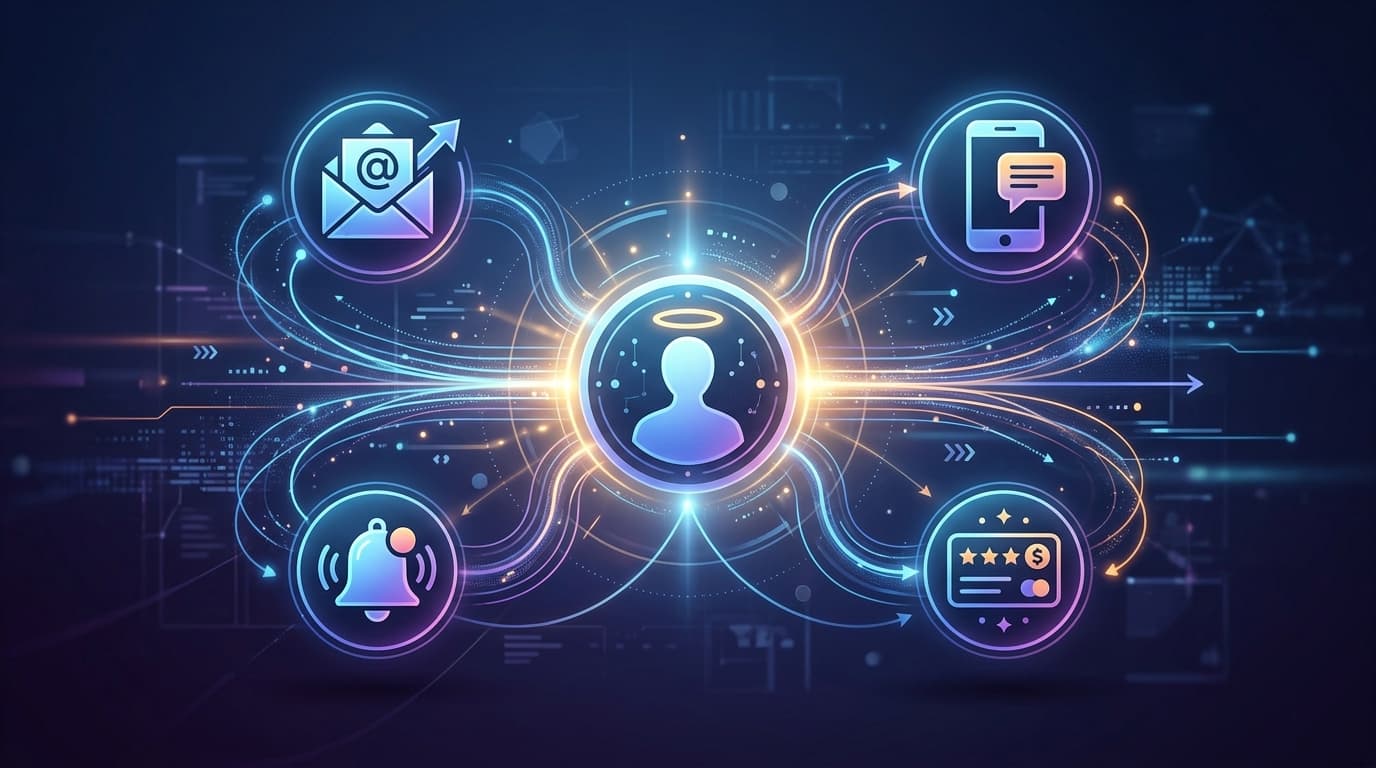
An effective post-purchase automation system goes beyond a single thank-you email. It requires an orchestrated multi-channel strategy that integrates email, SMS, push notifications, and loyalty programs, all powered by first-party data and intelligent segmentation. The goal is to create a cohesive and personalized customer journey that guides the user through key moments after purchase, strengthening their trust and encouraging repeat business.
The foundation of this architecture is a well-implemented CRM or CDP, capable of collecting, unifying, and activating customer data. These systems act as the operational brain, allowing you to track the behavior, preferences, and purchase history of each customer – essential information for authentic personalization.
Advanced Segmentation for Deep Personalization
Personalization is the key to making post-purchase communications relevant and non-intrusive. Advanced segmentation allows you to send the right message, at the right time, through the customer's preferred channel. Not all customers are the same, and treating them as such is a common mistake.
Examples of useful segmentation include:
- New buyers vs. repeat customers: New buyers need brand introduction and support; repeat customers need loyalty incentives.
- Buyers of specific products: Allows for suggesting complementary products or offering usage guides.
- High-Value Customers (HVC): Require VIP treatment, exclusive previews, or dedicated offers.
- Churn Risk Customers: Need targeted win-back campaigns with special offers or feedback surveys.
- Browsing or purchase behavior: For example, someone who bought a product but never visited the accessories section.
Using these segments, combined with automation, allows you to create dynamic communication flows that adapt to each customer's individual journey, maximizing engagement and CLTV.
Tool Selection and the Importance of Integration
To implement robust multi-channel automation, it's crucial to choose the right tools and ensure they can communicate seamlessly. A fragmented tech ecosystem is one of the main causes of failure in these strategies.
Key components include:
- Email Service Provider (ESP) Platforms: Such as Klaviyo, ActiveCampaign, or Mailchimp, with advanced automation features.
- SMS Marketing Platforms: Often integrated into ESPs or dedicated solutions like Twilio.
- Push Notification Platforms: For direct browser or mobile communications.
- Loyalty Program Systems: To incentivize repeat purchases and reward loyalty.
- Integration and Automation Tools: Platforms like Make (formerly Integromat) or Zapier are indispensable for connecting different systems and automating complex workflows, ensuring data flows correctly between CRM, ecommerce platform, and marketing platforms.
Integration is the backbone. Without a continuous and reliable data flow, advanced segmentation and personalization become impossible. This is where the expertise of a technical agency can make a difference, ensuring a solid and scalable implementation.
Operational Strategies: Post-Purchase Automation Sequences
Here are some of the most effective post-purchase automations every ecommerce business should implement:
- New Customer Welcome Series: More than just a thank you, it's an introduction to the brand, its values, product benefits, and an invitation to explore further. It can include a micro-guide to the purchased product.
- Enhanced Order Confirmation and Shipping Updates: Transform transactional emails into branding and subtle cross-selling/upselling opportunities. Include useful links, related product suggestions, or an invitation to join the community.
- Feedback and Review Requests: Solicit reviews after an appropriate time (e.g., 7-14 days after product arrival). Reviews are gold for social proof and product improvement.
- Usage Guides and Educational Content: For complex products or those requiring some learning, send tutorials, videos, or FAQs to help customers get the most out of their purchase. This reduces returns and increases satisfaction.
- Replenishment Reminders: For consumable or expiring products (e.g., supplements, coffee, cosmetics), automate reminders when it's time to repurchase, perhaps with a small discount.
- Win-Back Campaigns for Inactive Customers: Identify customers who haven't purchased for a certain period and send them special offers, new product announcements, or surveys to understand their inactivity.
- Loyalty Program Integration: Notify customers of earned points, achieved tiers, and available rewards. Encourage the use of points for new purchases.
These sequences, when well-orchestrated, create a continuous and valuable dialogue with the customer, turning every purchase into an opportunity to strengthen the relationship.
Common Mistakes to Avoid in Post-Purchase Automation
Even the best intentions can lead to poor results if certain common pitfalls are not avoided:
- Lack of Real Personalization: Sending generic messages to all customers is counterproductive. Personalization goes beyond inserting a name; it requires understanding individual needs and behavior.
- Over-Communication or Spamming: Bombarding customers with too many emails or SMS will lead them to unsubscribe or ignore your communications. Find the right balance and respect channel preferences.
- Ignoring Data and Segmentation: Launching automations without analyzing customer data and segmenting your audience is like navigating without a compass. Data is your guide.
- "Set-and-Forget" Mentality: Automations are not static solutions. They require continuous monitoring, A/B testing, and optimization to remain effective.
- Poor Integration Between Channels: If email, SMS, and push notifications are not synchronized, you risk sending duplicate or contradictory messages, creating confusion and frustration for the customer.
Avoiding these mistakes is crucial for building an automation system that is perceived as a valuable service, not an annoyance.
Measuring Impact and Continuous Optimization
To ensure your post-purchase automation strategies are effectively increasing CLTV, it's essential to monitor key metrics and adopt a continuous optimization approach. Implementation is just the beginning; true growth comes from analysis and iteration.
Key metrics to monitor include:
- Customer Lifetime Value (CLTV): The primary goal. Monitor how it changes over time for different customer segments.
- Repeat Purchase Rate: How many customers return to purchase after their first order.
- Average Order Value (AOV): The impact of cross-selling and upselling strategies.
- Churn Rate: How many customers stop purchasing. Win-back campaigns should aim to reduce this.
- Open Rate and Click-Through Rate of Automations: Indicate the effectiveness of your messages and their relevance to the audience.
- Conversion Rate of Automations: How many customers complete the desired action (e.g., repurchase, review).
Use A/B testing to experiment with different subject lines, content, calls-to-action, and timings. Each test provides valuable data to refine your automations and maximize their impact. Remember, optimization is an endless process in digital marketing.
Multi-channel post-purchase automation is not just a tactic, but a fundamental strategy for the growth and sustainability of any modern ecommerce business. Transforming one-time buyers into loyal, high-value customers is the most profitable investment you can make. It requires precise technical implementation, a deep understanding of customer behavior, and a targeted content strategy. If the complexity overwhelms you or if you desire an implementation that guarantees measurable results, expert support is crucial. Learn more about our ecommerce automation solutions or contact us for a personalized consultation and start building lasting relationships, transforming your ecommerce into a sustainable profit machine.
Related articles
AI Predictive Analytics for Ecommerce: Implementation Strategies to Maximize CLV and ROI
Transform your e-commerce data into actionable predictions with AI predictive analytics. Discover how to identify high-value customers, predict churn, and optimize marketing campaigns for superior ROI.
Advanced Lead Qualification & Nurturing Automation with Server-Side Tracking
Learn how to implement advanced automation systems to qualify, segment, and nurture leads using precise behavioral data collected via server-side tracking, optimizing CRM and sales efficiency.
Shopify Review & Feedback Automation: A Practical Guide with Make/Zapier
Learn to automate customer review and feedback collection on Shopify using Make or Zapier. Enhance social proof, SEO, and customer experience, turning feedback into a strategic asset for your ecommerce.