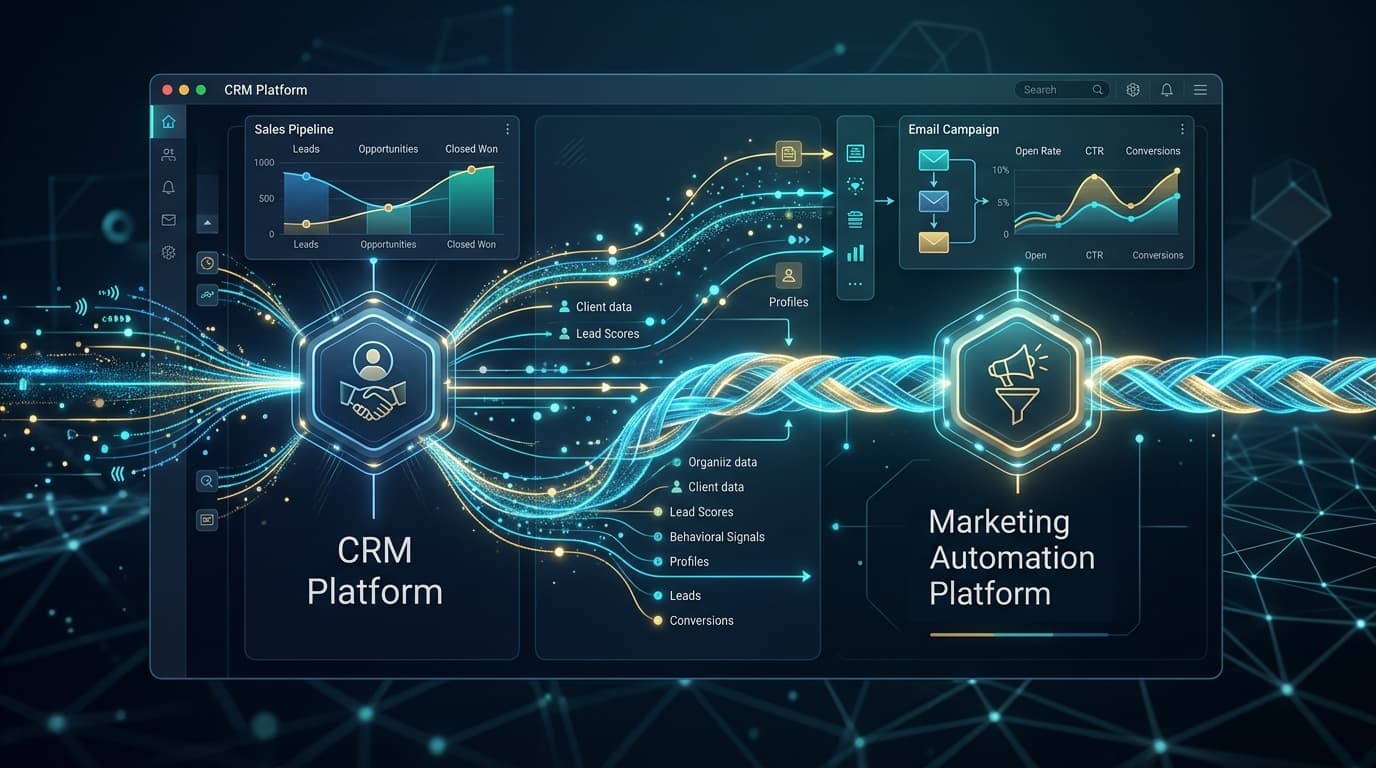
In today's digital landscape, the ability to manage leads efficiently and personally has become a critical success factor. Many companies find themselves operating with separate tools for customer relationship management (CRM) and marketing automation activities. This fragmentation creates data silos, slows down processes, and prevents a unified customer view, compromising lead nurturing and sales performance.
The integration of CRM and marketing automation is no longer a luxury, but a strategic necessity. In an increasingly competitive market, personalization and efficiency are paramount. An integrated system allows you to break down barriers between sales and marketing teams, ensuring a fluid customer journey, relevant messages at the right time, and timely follow-up. This is essential not only for converting qualified leads but also for maximizing the return on investment (ROI) of your marketing and sales activities.
Why Integration is Crucial Now: Overcoming Silos and Accelerating Conversions
Related deep dives: Advanced Lead Qualification & Nurturing Automation with Server-Side Tracking · How Server-Side Tracking Revolutionizes Lead Scoring and CRM Segmentation
The main problem that CRM and marketing automation integration solves is the disconnection between sales and marketing teams' data and processes. Without integration, marketers might not have access to the latest information on lead interactions with sales reps, and sales reps might not be aware of the marketing campaigns a lead has been exposed to. This leads to:
- Inconsistent Messaging: Leads receive communications that are not aligned between marketing and sales.
- Wasted Time: Teams spend time manually syncing data or searching for information.
- Lost Leads: Qualified leads are not followed up on promptly or appropriately.
- Partial Customer View: Inability to have a complete and personalized customer journey.
Integration resolves these issues by creating a bidirectional and automated flow of information. The CRM provides valuable data on existing customers and qualified leads to the marketing automation system, which in turn enriches the CRM with data on marketing interactions (email opens, clicks, content downloads). This strategic alignment allows for:
- Advanced Personalization: Create highly targeted nurturing campaigns based on comprehensive data.
- Accurate Lead Scoring: Assign scores to leads based on marketing and sales behaviors.
- Fast and Informed Handoff: Pass qualified leads from marketing to sales with all necessary information.
- Better Alignment: Marketing and sales work with the same goals and data.
The result? A shorter sales cycle, higher conversion rates, and increased customer satisfaction.
Operational Steps for Effective Integration
Integration is not a simple 'set it and forget it' task. It requires careful planning and methodical execution. Here are the key steps:
1. Define Clear Goals and Customer Journey Mapping
Before you begin, it's crucial to establish what you want to achieve from the integration. Do you want to reduce the sales cycle? Improve lead quality? Increase conversion rates? These objectives will guide your entire strategy. Next, map out the entire customer journey, from initial acquisition through conversion and beyond. Identify all touchpoints and the data needed at each stage. This will help you understand what data needs to be synchronized and in which direction.
2. Platform Selection and Data Synchronization Strategy
Ensure that your CRM and marketing automation platforms are compatible or that native connectors exist. If not, you may need third-party integration tools (like Zapier or Make) or to develop custom APIs. Define a data synchronization strategy: what data needs to be exchanged? How frequently? Should synchronization be one-way or two-way? It's crucial to establish clear rules to avoid duplicates or inconsistencies.
3. Implementation of Lead Scoring and Nurturing Workflows
With data flowing between systems, you can implement a robust lead scoring system. This will assign a score to leads based on their interactions (e.g., website visits, ebook downloads, email opens) and demographic/firmographic data. Automated nurturing workflows can then be triggered based on this score and the lead's behavior, sending relevant content to guide them through the funnel. When a lead reaches a certain score, they are automatically designated as a Marketing Qualified Lead (MQL) and passed to the sales team.
Common Mistakes to Avoid
Even the best intentions can fail without proper execution. Here are some pitfalls to watch out for:
- Lack of Sales and Marketing Alignment: Technical integration is useless if teams don't collaborate and agree on definitions (e.g., 'qualified lead') and processes.
- Inconsistent or Poor Quality Data: Integration amplifies data quality. If the initial data is dirty, the output will be equally unreliable. Invest in data cleansing and standardization.
- Ignoring Customer Journey Mapping: Without a clear understanding of the customer's path, automations may be irrelevant or counterproductive.
- Lack of Testing and Iteration: Do not launch the integration without thorough testing. Synchronization or workflow issues can cause significant damage. Constantly monitor and make improvements.
- Over-automation Without Personalization: Automation is powerful, but too much without personalization can feel impersonal and alienate leads. Find the right balance.
Measuring the Impact and ROI of Integration
Once the integration is implemented, it's crucial to measure its impact to justify the investment and further optimize processes. Here are some key metrics to monitor:
- Lead Qualification Rate: How many leads move from MQL to SQL (Sales Qualified Lead) and then to opportunity?
- Sales Cycle Length: Has integration reduced the time it takes to convert a lead into a customer?
- Conversion Rate: How many marketing-generated leads convert into paying customers?
- Marketing Campaign ROI: Has integration improved the effectiveness of campaigns and their economic return?
- Customer Lifetime Value (CLV): Has integration contributed to greater customer loyalty and long-term value?
- Operational Efficiency: How much time do teams save thanks to automation and data synchronization?
Use unified dashboards to monitor these metrics and present results to decision-makers. This will allow you to demonstrate the value of integration and identify areas for further optimization.
When to Seek Support from External Experts
Integrating complex systems like CRM and marketing automation can be challenging. If your company lacks internal resources with deep technical expertise in API integration, data management, complex workflow development, or if the data volume is very high, the intervention of a specialized agency like AE Digital can make a difference. Our experts can help you to:
- Define a tailored integration strategy.
- Select the most suitable technologies.
- Implement custom connectors or configure third-party solutions.
- Ensure data cleansing and migration.
- Develop advanced nurturing and lead scoring workflows.
- Train your team and provide continuous support.
Don't let technical complexity hinder your business growth. An experienced partner can ensure a smooth implementation and maximize the benefits of integration.
Conclusion: A Unified Future for Marketing and Sales
The integration of CRM and marketing automation is a strategic investment that pays off in terms of efficiency, personalization, and ultimately, revenue growth. By breaking down silos between departments and providing a unified customer view, companies can create more relevant experiences, accelerate the sales cycle, and build stronger relationships. It's not just about technology, but about a cultural shift that aligns marketing and sales towards a common goal: customer conversion and retention.
If you're ready to transform your lead management and take your sales and marketing strategy to the next level, now is the time to act. Explore our automation solutions or contact us for a personalized consultation. We are here to help you implement a system that truly works for your business.
Related articles
Advanced Lead Qualification & Nurturing Automation with Server-Side Tracking
Learn how to implement advanced automation systems to qualify, segment, and nurture leads using precise behavioral data collected via server-side tracking, optimizing CRM and sales efficiency.
How Server-Side Tracking Revolutionizes Lead Scoring and CRM Segmentation
Discover how to implement server-side tracking to gain accurate first-party data, enrich CRM profiles, and automate lead qualification, ensuring targeted sales follow-up and increased ROI.
Shopify Review & Feedback Automation: A Practical Guide with Make/Zapier
Learn to automate customer review and feedback collection on Shopify using Make or Zapier. Enhance social proof, SEO, and customer experience, turning feedback into a strategic asset for your ecommerce.