Define the conversion before designing the page
A B2B landing page should not persuade everyone. It should help the right person take the next step with accurate expectations. Before discussing layouts or buttons, define the audience, problem, offer, action and lead-quality criterion. If nominal conversion rises while sales receives unsuitable contacts, the page is not creating business value.
Write an operational statement: for this segment arriving from this campaign, the page should produce this action, and the CRM should verify this condition. Then connect the promise in the advertisement or email to the landing-page headline.
Create a message-match matrix
For every source, list intent, promise, main objection, required proof and call to action. You do not need one page for every keyword. Group genuinely compatible intentions and personalize only where the offer changes. Keep terminology, awareness level and journey stage consistent. Comparison traffic needs criteria and differences; visitors looking for a supplier want to understand process, reliability and the next step. The matrix prevents cosmetic variants with no strategic reason.
Make the value proposition specific and verifiable
The opening block should answer four questions: who the offer is for, which problem it solves, which outcome it enables and what happens after a click. Avoid generic superlatives and promises without conditions. A credible proposition also defines its boundaries. Supported platforms, project types, prerequisites or process stages can help visitors qualify themselves. Headline, supporting copy and CTA should work together without forcing people to decode an abstract slogan.
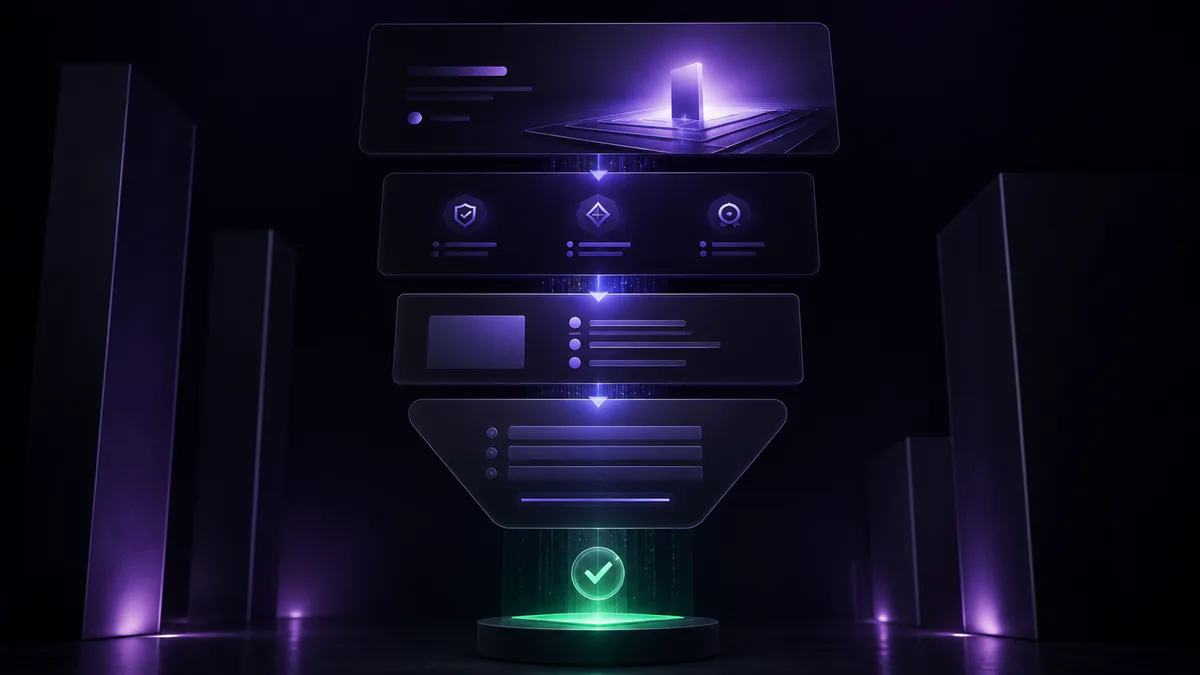
Arrange the rest of the page around questions that block a decision. After the value, show the mechanism, then proof, scope, process, objection handling and the action. This sequence is not a rigid template. A simple request may need fewer sections, while a complex solution needs more context.
Use evidence that reduces a concrete risk
Logos, testimonials and case studies matter when they answer a real question. Connect every proof element to a claim. A case study can explain the starting situation, intervention, constraints and result. A testimonial can clarify collaboration and reliability. Credentials or partnerships can support competence. When a metric cannot be verified, describe the process and qualitative evidence precisely.
Build a hierarchy of trust
The proof closest to a promise should appear near the point where doubt occurs. A technical service may need architecture, verification methods and ownership; consulting may need sample deliverables and expertise; an established offer may benefit from comparable cases. Explain the next action too: who will respond, what information will be needed and whether the first conversation is exploratory. Transparency reduces perceived risk without artificial scarcity, countdowns or pressure.
Design the CTA and form as one journey
The CTA should name the action rather than say submit. Repeat it where the visitor has enough context, while preserving the same promise. The form should collect only what is needed to deliver the stated next step. Each field adds work and data-handling responsibility. Ask now for what is needed now, then gather later details during qualification. A shorter form is not always better: for a high-consideration offer, a few focused questions can filter incompatible enquiries and prepare a useful conversation.
Apply progressive disclosure and accessibility
When many details are required, divide the journey into understandable steps and show what remains without creating surprises. Preserve entries after validation errors. Every control needs an associated visible label, clear instructions and an error that explains how to fix the issue. Use appropriate input types and autocomplete attributes, a logical keyboard order and a visible focus indicator. Test with a keyboard, zoom, a screen reader and mobile devices.
Explain why information is needed for the sales process and link to privacy information without preselecting unnecessary consent. Protect the form from spam through mechanisms that do not punish people. After submission, avoid ambiguous states: prevent duplicates while the request is processing, handle network failures and confirm only after the backend accepts the data. If the whole journey needs review, our conversion-rate improvement solution starts with friction, messaging and measurement quality.
Treat performance, mobile and thank-you as conversion work
Speed supports comprehension. A page that shifts, delays its primary block or loads unnecessary elements introduces friction before the form. Optimize images, fonts and scripts, reserve layout space and test on realistic networks and devices. Do not chase one technical metric while ignoring functional errors. Loading should be fast, stable and capable of completing the action. Check browsers, screen sizes and limited-JavaScript cases where the flow supports them.
The thank-you page is part of the conversion. Confirm what was received, state the timing and channel of the next contact, offer a way to correct information and prevent accidental repeat submissions. It can suggest a relevant resource but should not unexpectedly change the offer. Use a request identifier to connect the web event and CRM record without placing personal data in URLs or analytics parameters.
Measure from behavior to lead quality
Define an event map before launch. A useful sequence can include landing view, CTA interaction, form start, validation error, accepted submission and confirmation view. GA4 may collect some form interactions automatically, but event availability does not prove that it represents your actual process. Check naming, triggers, duplicates and consent. Never send field contents or other personal information to analytics platforms.
Connect the page and CRM without mixing levels
Submission rate describes the form, not the commercial outcome. Pass the permitted source, campaign, variant and technical identifier to the CRM. Define stages such as new lead, qualified lead, opportunity and customer, with criteria and owners. Analyze initial conversion alongside qualification, opportunity and final outcome. If a variant generates more submissions but fewer suitable leads, it is not necessarily a winner. Reconcile accepted requests, created records and duplicates to distinguish page problems from integration failures.
Heatmaps and recordings can reveal ignored zones, unexpected clicks or hesitation, but they do not explain intent by themselves. Use them as signals for hypotheses, with suitable privacy settings, and combine them with errors, feedback and funnel data. Segment by source and device only when the sample supports responsible interpretation. Avoid definitive conclusions from a few cases or selected recordings.
Run tests as decisions, not decoration
Every experiment should state the problem, hypothesis, change, primary event and quality guardrail. Change a coherent set linked to that hypothesis. When testing message match, align headline, evidence and CTA. When testing the form, do not change the offer at the same time. Verify assignment, variant persistence and tracking before interpreting results. Do not stop as soon as one line appears better, and do not present uncertain differences as universal truths.
Build a backlog from evidence: queries, campaigns, sales conversations, form errors, feedback and observed behavior. Assess impact, confidence and cost, then document the learning even when a variant does not win. There is no universal page length, field count or conversion benchmark. What matters is the fit among intent, risk, offer value and lead quality.
An effective B2B landing page makes the promise, proof and next step clear. An accessible form allows people to complete the request, and measurement follows the contact to a meaningful outcome. Begin with one high-value page, fix evident failures and then experiment with discipline. For a combined diagnosis of messaging, experience and data, contact AE Digital Agency. The plan will be tied to verifiable goals, not isolated cosmetic changes.
Frequently asked questions
How many fields should a B2B form contain?
There is no universal number. Ask for the information needed to deliver the promised next step and for proportionate qualification. When many details are required, use clear stages and assess both submission and lead quality.
What is the difference between a conversion and a qualified lead?
A page conversion means the action was completed. Qualification verifies that the contact meets defined commercial criteria. A useful analysis connects both levels in the CRM.
Are heatmaps enough to decide how a page should change?
No. They show interaction patterns, not certain motivations. Use them to create hypotheses alongside funnel data, errors, feedback and sales conversations, with appropriate privacy controls.
Which events should a landing page track?
A useful baseline includes page view, CTA, form start, errors, accepted submission and confirmation. Then connect the request to CRM stages without sending personal data to analytics tools.
Related articles
Building Interactive Lead Generation Funnels: A CRM Automation Guide
Discover how interactive lead generation funnels, integrated with CRM, can transform generic leads into qualified opportunities. A practical guide to smart automation.
Landing Page Optimization with Server-Side Data: Boost Lead Gen Conversions
Discover how server-side tracking revolutionizes landing page optimization, enhancing data quality, personalization, and A/B testing for effective, privacy-compliant lead generation.
Sales funnel: structure, psychology and conversion optimization
How to build a funnel that actually converts: from landing page to email sequence. Structure, psychology and technical optimization.